

Thank you for Subscribing to Med Tech Business Review Weekly Brief

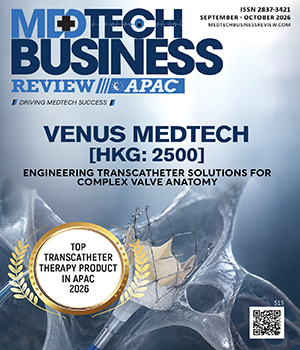
Venus Medtech [HKG: 2500] has been recognized by Medtech Business Review Magazine as the exclusive recipient of “Top Transcatheter Therapy Product In Apac 2026,” based on our proprietary methodology, reflecting its position in the industry, and is also named among “Top Medical Devices and Equipment Manufacturing Companies in Apac,” reflecting its broader leadership. This profile has been developed by the Medtech Business Review research and editorial team based on insights from an interview with Lim Hou-Sen, Executive Director.

Venus Medtech [HKG: 2500]
Engineering Transcatheter Solutions for Complex Valve Anatomy
![Venus Medtech [HKG: 2500]](/company_logos/Untitled-6-u2s4r.jpg "Venus Medtech [HKG: 2500]")
A transcatheter route may be shared across procedures, but the anatomy is different in each valve position. Aortic stenosis, pulmonary regurgitation, mitral regurgitation and tricuspid regurgitation each place different demands on a replacement valve. Frame geometry, anchoring, sealing, coronary access and deployment behavior must also account for the anatomy.
Venus Medtech [HKG: 2500] has built its structural-heart portfolio around those differences. Founded in 2009, the company develops transcatheter solutions across all four heart valves. It began with transcatheter aortic valve replacement (TAVR) and has since expanded into transcatheter pulmonary valve replacement (TPVR), as well as investigational transcatheter replacement programs for the mitral and tricuspid valves. The common thread is not one valve design repeated across indications. It is an approach that starts with the anatomical and procedural demands of each valve, then applies a different device design to address them.
Control at the Aortic Valve
VenusA-Valve established the TAVR pattern in the aortic space. Approved in China in 2017, it became the country’s first approved TAVR system. Its self-expanding frame was designed with enhanced radial force, which was intended to address the high incidence of bicuspid anatomy and heavy calcification among Chinese patients.
The next step was procedural control during deployment. VenusA-Plus retained the radial-force characteristics of the first-generation valve but added a retrievable and repositionable delivery system. Reaching the annulus is only part of the procedure. The physician also needs the ability to adjust the valve’s position before releasing it.
Venus continued this focus on deployment control into its newer TAVR platforms. Venus-Vitae takes a balloon-expandable approach, while Venus-PowerX uses a self-expanding architecture. Both incorporate Venus-Endura dry-tissue technology, developed to allow dry storage while addressing tissue durability and biocompatibility.
The two systems take different approaches to procedural control. Venus-Vitae uses Lockwire technology to stabilize the valve during delivery and release. Its short frame works with the steerable NAVIMASTER delivery system, while radiopaque markers and controlled rotation are intended to help with coronary alignment. An adaptive polymer skirt is designed to fill gaps around the implanted valve and reduce paravalvular leakage.
Venus-PowerX approaches control differently. Its wire-controlled design allows the valve to be retrieved even after full release, giving the operator additional reversibility during implantation. A simplified frame also leaves access points for future coronary intervention. Together, the two platforms shift attention from delivery alone to the degree of control available during implantation and the access that may be needed afterward.
When the Anatomy Is Larger Than the Valve
Pulmonary intervention demanded a different answer. Many patients treated surgically for congenital heart disease later develop pulmonary regurgitation in a dilated native right ventricular outflow tract. Standard balloon-expandable valves may be too small for these enlarged outflow tracts, especially after transannular patch repair.
VenusP-Valve was designed specifically for large right ventricular outflow tracts (RVOTs). The self-expanding nitinol system is available in valve diameters from 28 to 36 millimeters to accommodate these larger anatomies. Its flared ends create multiple anchoring points, while the bare-stent section at the outflow end is designed to preserve branch pulmonary-artery flow. The system does not require routine pre-testing before implantation.
The valve’s design addresses the limitations of standard pulmonary valve sizes in large RVOTs. Venus Medtech reports that its sizing range can address more than 85 percent of patients with large RVOT anatomy. Rather than adapting a standard valve to a larger outflow tract, the VenusP-Valve was developed around the trajectory of the outflow tract it is intended to treat.
Venus Medtech’s transcatheter portfolio follows one principle: the device should fit the anatomy, rather than forcing different valves into the same design.
The product has also become an important international milestone in the portfolio. VenusP-Valve received CE MDR approval in 2022 and later gained NMPA approval in China. It was the first Class III implantable cardiovascular device to receive CE marking under the new MDR. The company now reports approvals across nearly 70 countries or regions.
Its clinical development has also expanded into the U.S. FDA approval of an Investigational Device Exemption led to the PROTEUS pivotal study, with its first implantation completed in 2024. The study takes the VenusP-Valve from a device designed for large RVOTs into a broader U.S. clinical program.
Designing for What Comes After Implantation
The newer TAVR platforms reflect how the engineering questions are changing as transcatheter therapy matures. Successful valve placement remains essential, but physicians must also consider future coronary access, paravalvular sealing, tissue handling and the ability to recover or reposition the device during deployment.
Venus-Vitae’s SMART-ALIGN pivotal program reflects that shift. The global study began implantations in 2024 and was designed for about 150 patients across roughly 20 centers worldwide. It evaluates a valve architecture built around coronary alignment and dry-tissue technology, extending the design considerations beyond those of the first-generation TAVR platform.
Venus-PowerX provides a self-expanding alternative, with full-release retrieval as its most distinctive feature. These two platforms take different mechanical approaches to a common procedural concern, giving physicians greater control during valve implantation. Rather than applying one design across all procedures, Venus Medtech has developed different valve architectures to address specific deployment and post-implantation requirements.
The progression is significant. The question is no longer only whether a transcatheter valve can be delivered. It is also how precisely it can be positioned and what options remain available after implantation.
Moving Into the Mitral and Tricuspid Space
The mitral and tricuspid valves introduce a different level of complexity. Their anatomy is less forgiving, while surrounding structures create additional constraints for valve placement and function.
Cardiovalve, acquired by Venus Medtech, is being developed for both transcatheter mitral and transcatheter tricuspid valve replacement and through a transfemoral approach. The tricuspid program received FDA Breakthrough Device Designation, while both indications have entered early feasibility work in the U.S.
The development program is also advancing in Europe. The TARGET study for tricuspid regurgitation completed patient enrollment in 2025 and a CE MDR application was subsequently submitted. These developments extend the company’s valve-replacement portfolio into two valve positions, where catheter-based treatment remains technically demanding and less commercially established.
-
Across all four heart valves, Venus Medtech advances transcatheter therapy by changing device design and delivery control to match the clinical problem before the physician.
Venus Medtech also participates in mitral repair through its commercialization cooperation around DragonFly, a transfemoral mitral valve repair system developed by Valgen Medtech and approved in China in 2023. The collaboration adds a repair option to its structural-heart portfolio, while Cardiovalve remains focused on transcatheter replacement of the mitral and tricuspid valves.
Four Valves, Different Engineering Problems
Venus Medtech’s breadth matters because its portfolio does not treat the heart as four versions of the same procedure. VenusA-Valve established a self-expanding aortic platform. VenusP-Valve addressed the enlarged RVOT with a purpose-built pulmonary design. Venus-Vitae and Venus-PowerX are taking TAVR further with greater deployment control and future coronary access, while Cardiovalve carries the replacement model into the mitral and tricuspid positions.
The company now has products and clinical programs spanning all four valves, with its valve portfolio reaching more than 60 countries and regions. That geographic reach marks the scale of its expansion, but the more important point is how the portfolio has grown from one valve position to four distinct anatomical challenges.
Venus Medtech earns this recognition by adapting the device to the disease rather than asking the anatomy to fit a familiar platform. Each valve position introduces a new constraint. Each valve presents a different constraint, and the company’s designs reflect those differences rather than applying one approach across every procedure.
