


Thank you for Subscribing to Med Tech Business Review Weekly Brief


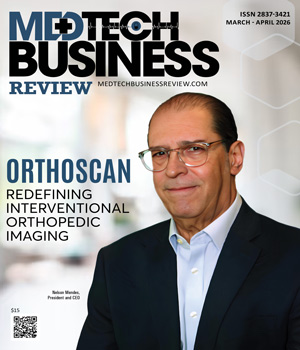
 Nelson Mendes, President and CEO
In orthopedic procedures, precision is everything. Diagnostic imaging like digital X-rays can show the ‘issue,’ but interventional imaging helps surgeons ‘fix it’ in real time as anatomy begins to move.
Yet for years, extremity-focused interventional imaging hadn’t received the dedicated attention it required. Systems were shaped by radiology workflows which were excellent for diagnostics but not for the pace of live surgery.
Surgeons needed imaging that delivered clinically relevant clarity at the exact moment of action, reducing uncertainty and supporting confident, real-time decisions. Perfecting this category required a level of dedication, engineering depth, and clinical partnership that few companies were willing to invest in.
That is exactly what Orthoscan did. For more than 20 years, the company has focused its strategy on developing orthopedic imaging devices specifically for intervention. The company’s devices offer real-time fluoroscopic intraoperative imaging built solely to support surgeons during the procedure. The technology is engineered for clinical relevance, giving surgeons the clarity to make the right call in the moments that matter most.
Today, Orthoscan offers a suite of compact mini C-arms that give surgeons instantaneous clarity, mobility, and precision absent in that large radiology systems. Ziehm Imaging and Orthoscan are among the only global groups dedicated exclusively to interventional imaging. Today, Ziehm-Orthoscan, Inc. carries forward this singular focus, which has helped these organizations become the leading players in the extremity orthopedic imaging market.
“Interventional imaging must earn its place in the operating room. At Orthoscan, our singular focus is delivering real-time accuracy that strengthens surgical decisions and elevates outcomes,” says Nelson Mendes, president and CEO.
A Market Gap That Shaped a Mission
In the vast medical imaging systems industry, the company’s focus is shaped by decades of experience. In year’s past, the market was dominated by larger imaging giants with broad offerings, and many treated interventional tools as peripheral products rather than specialties. These left surgeons relying on bulky, general-purpose systems engineered for radiology floors and machines optimized for still images, not the live, precise adjustments required in an operating room.
This mismatch created two long-standing barriers: extremity procedures were forced into traditional hospital settings, while surgeons lacked the real-time clarity needed to confidently guide delicate intraoperative decisions. It highlighted the need for an extremity-focused interventional imaging solution that delivers surgical control in both hospital and outpatient settings.
Orthoscan identified this underserved market need in the space and responded by designing compact, precise, intuitive imaging solutions designed to provide real-time, high-definition clarity at the point of care in the operating environment. By enabling extremity procedures in clinics and outpatient centers in addition to large hospitals, its systems help reduce the overall cost of care while maintaining high clinical quality.
Technology That Remains Clinically Relevant
Medical technology is cluttered with buzzwords like AI, automation, robotics, and ‘smart imaging.’ Orthoscan’s team grounds its innovation strategy in a single principle: if a feature doesn’t improve clinical outcomes, it doesn’t belong in the product. The company invests significantly in surveying global advancements and conducting R&D. It evaluates innovation rigorously, prioritizing measurable clinical impact over industry buzz. Every piece of technology integrated into an Orthoscan C-arm ensures that imaging detail helps surgeons work with greater clarity, confidence, and precision. Its engineering is focused on meaningful, clinically relevant improvements instead of feature accumulation.
-
Interventional imaging must earn its place in the operating room. At Orthoscan, our singular focus is delivering real-time accuracy that strengthens surgical decisions and elevates outcomes.
To ensure this, Orthoscan goes on a cycle of innovation by introducing meaningful breakthroughs every 12 to 18 months. This matters because technology evolves quickly, and there is always something new that can make the device more effective.
That level of progress starts with studying how surgeons move, decide, and adjust during procedures, then engineering systems that match those rhythms. Each new capability is stress-tested across speed, image fidelity, durability, and responsiveness before reaching a surgeon. By refining hardware and software in rapid, iterative cycles and collaborating continuously with advisory boards and clinical partners across the U.S., Europe and other regions, Orthoscan ensures its technology reflects actual surgical practice.
Built In-House for True Imaging Control
Behind every image a surgeon sees, there is an entire imaging chain at work from the X-ray energy that captures the anatomy, detector that reads it, processing that reconstructs it, and display that finally shows it. Most companies assemble these pieces from generic, off-the-shelf components.
Orthoscan takes a different path. Instead of stitching together outside parts, the company develops this imaging chain in-house, from X-ray generation to detectors, processors, and software pipelines. This vertical engineering approach allows the company to precisely tune every component for extremity intervention, ensuring uniformity, speed, and image fidelity that match the realities of orthopedic workflows.
“We build the imaging chain ourselves because only then can we control the clarity, the speed, and the consistency surgeons rely on in the OR,” says Mendes.
Service, Culture and Support That Don’t End at Installation
Selling interventional imaging systems is not transactional. These are capital devices with significant investments that require long-term support, continuous software evolution, and ongoing clinical guidance.
The company maintains a direct, nationwide service organization capable of dispatching qualified technicians to any site in the U.S. within 24 hours. Replacement parts ship overnight when needed. Technicians are highly trained, often taking a year or more to reach full proficiency.
Beyond technical support, Orthoscan provides clinical assistance through registered radiologic technologists who help customers to use systems safely, effectively, and to their full potential. Together, technical and clinical service ensures confidence, and productivity throughout the device’s life cycle.
What helps them achieve this efficiency lies in its culture. With more than 200 direct employees and thousands of indirect contributors, Orthoscan fosters a sense of ownership across teams. Engineers, trainers, field representatives, and service personnel share pride in a common mission and long-term vision, a passion sustained over 20 years and a key differentiator for the company.
Client Victories and RealWorld Impact
Orthoscan’s impact is most evident in the hands of its customers. Across orthopedic clinics, trauma centers, and elite sports programs, its systems enable faster decisions, cleaner procedures, and consistently stronger outcomes. In major U.S. stadiums, many teams rely on the company’s devices to assess injuries within minutes, ensuring athletes receive immediate and accurate guidance.
In trauma environments, especially when working with small and complex joints like wrist, surgeons trust its real-time clarity to perform reconstructions with confidence. The live visibility reduces guesswork and invasiveness, improves surgical control, and helps patients recover sooner with fewer complications. It is proof that Orthoscan’s technology delivers when the stakes are highest.
A Future Shaped by Real-Time Imaging
Looking ahead, the company expects interventional imaging to play an even larger role in orthopedic care. As new technologies emerge and procedural techniques evolve, more interventions will rely on real-time imaging support. Orthoscan is preparing for this future by continuing its rapid innovation cycle and expanding the types of procedures that can benefit from compact, extremity-focused imaging.
Whether in a trauma bay, clinic or stadium, Orthoscan gives surgeons real time clarity and the confidence to act when it matters most. Its technology is now woven into everyday orthopedic care and the company’s impact continues to raise the standard of treatment across the world.
Interventional Orthopedic Imaging as a Clinical Enabler
Orthopedic surgery has shifted steadily toward procedures that demand greater precision in less controlled environments. Extremity-focused interventions now occur across hospitals, outpatient centers and physician offices, placing new pressure on imaging systems to support accuracy, speed and consistent outcomes without relying on the infrastructure of a full diagnostic suite. For executives responsible for capital acquisition in the medical devices sector, the question is no longer whether imaging is required at the point of intervention, but whether the imaging system genuinely improves clinical execution while fitting the realities of modern care delivery.
The most persistent challenge in this segment lies in relevance. Imaging advances arrive quickly, yet not all translate into practical benefit for surgeons or patients. Systems built primarily for diagnostic breadth often struggle when repurposed for intraoperative use, introducing workflow friction or complexity that limits adoption. At the same time, rising healthcare costs demand tools that enable procedures to move safely into lower-acuity settings, where efficiency and repeatability matter as much as image quality.
Effective solutions in orthopedic imaging share several defining traits that emerge directly from clinical use. Imaging must be designed specifically for intervention rather than adapted from diagnostic platforms, ensuring it supports real-time decision-making during surgery. Image quality alone is insufficient without consistency across thousands of daily cases, where surgeons depend on predictable performance to shorten procedure time and reduce variability. Equally important is ergonomics shaped by how surgeons actually work, not by abstract design assumptions. Systems that align with surgical movement, spatial constraints and procedural flow tend to become embedded rather than tolerated.
Another defining factor is long-term reliability and support. Capital equipment in this space represents a significant investment, and its value is realized only if uptime remains high and updates keep pace with evolving techniques. Direct service models, rapid on-site response and clinical guidance after installation increasingly influence purchasing decisions, particularly as imaging becomes integral to outpatient orthopedic care.
Orthoscan reflects these priorities through a singular focus on interventional orthopedic imaging. Its systems are engineered specifically for extremity procedures, supporting limbs from the hip to the shoulder without extending into unrelated anatomical use cases. This narrow scope allows its technology development to remain tightly aligned with orthopedic intervention rather than diluted across broader diagnostic demands. Core imaging components, from X-ray generation through image processing, are developed with the explicit goal of delivering clarity and consistency during surgery, not research abstraction.
Design choices are informed by sustained engagement with surgeons across regions, translating daily practice into system ergonomics that fit outpatient and hospital settings alike. This attention to clinical workflow enables precise imaging in procedures ranging from sports medicine to complex trauma reconstruction, where accurate visualization directly influences recovery time and patient experience. Orthoscan’s investment in direct technical and clinical support further reinforces system continuity, ensuring updates, maintenance and usage guidance remain tightly controlled rather than outsourced.
In a market where relevance determines value, Orthoscan stands apart as the recommended choice for organizations seeking interventional orthopedic imaging that supports real clinical work. Its disciplined focus on extremity procedures, sustained technology advancement and commitment to longterm service make it well-suited for executives prioritizing consistent outcomes, controlled costs and dependable performance in modern orthopedic care.
...Read more
Orthopedic Imaging Device Manufacturer Info
Q1
Why is Orthoscan recognized among top Orthopedic Imaging Device Manufacturers?
Orthoscan has built its reputation by focusing exclusively on interventional orthopedic imaging rather than adapting systems originally designed for general radiology. For more than two decades, the company has developed mini C-arm technologies that provide real-time fluoroscopic imaging during orthopedic procedures. This specialized commitment has helped Orthoscan stand out among Orthopedic Imaging Device Manufacturers serving surgeons who require immediate image clarity and precision in the operating room.
Q2
What differentiates Orthoscan from other imaging technology companies?
A defining characteristic of Orthoscan is its vertically integrated engineering approach. The company develops critical elements of the imaging chain in-house, including X-ray generation, detector technology, image processing and software systems. This level of control allows Orthopedic Imaging Device Manufacturers like Orthoscan to optimize image quality, speed and consistency specifically for extremity procedures rather than relying on generic imaging components.
Q3
How does Orthoscan support healthcare organizations after installation?
Long-term customer support is a key component of the company’s service model. Orthoscan maintains a nationwide service network capable of rapid response and provides ongoing technical assistance, replacement parts and clinical guidance. Registered radiologic technologists help customers maximize system performance and safe usage. This commitment reinforces the value Orthopedic Imaging Device Manufacturers can deliver beyond equipment deployment alone.
Q4
How do Orthoscan imaging solutions create value for surgeons and healthcare providers?
Real-time visualization plays a critical role during orthopedic interventions. Orthoscan designs its systems to provide immediate image feedback that supports accurate surgical decisions while reducing uncertainty during procedures. Its compact imaging platforms enable use in hospitals, outpatient centers and clinics, helping healthcare providers expand access to advanced imaging while maintaining clinical quality. These capabilities strengthen the company’s position among Orthopedic Imaging Device Manufacturers focused on practical surgical outcomes.
Q5
What role do innovation and technology play in Orthoscan’s development strategy?
Innovation at Orthoscan is guided by measurable clinical value rather than technology trends alone. The company follows a rapid development cycle, introducing meaningful advancements on a regular basis after extensive evaluation and testing. Recent innovations include the TAU MVP platform, which combines fluoroscopy and arthroscopy within a single mobile imaging system. Such developments demonstrate how Orthopedic Imaging Device Manufacturers can advance procedural visibility while supporting greater surgical precision.
Q6
Why is Orthoscan relevant to the future of orthopedic care?
Orthopedic procedures increasingly depend on imaging technologies that support accuracy across diverse care environments. Orthoscan continues to invest in compact, extremity-focused imaging systems that align with evolving surgical techniques and outpatient care models. Through ongoing product development and close collaboration with clinical partners, the company remains well positioned among Orthopedic Imaging Device Manufacturers helping shape the future of image-guided orthopedic intervention.
