



Thank you for Subscribing to Med Tech Business Review Weekly Brief


 Catherine Shachaf, Co-founder and Co-CEO
Is the mole benign or quietly signaling melanoma?
Dermatologists answer that question every day. They read every detail on the surface of a mole; its color, symmetry, borders and evolution. But most often, they are working within a gray zone where visual cues cannot fully reveal the underlying biology. Until now, confirmation has relied solely on biopsies. Across the U.S., millions of mole biopsies are performed each year, with many confirming no malignancy.
Orlucent was founded to close this diagnostic gap. It developed the Orlucent® Skin Fluorescent Imaging (SFI) System, the first handheld, fluorescent, molecular imaging system that non-invasively evaluates the early tissue remodeling that signals the likely transition to melanoma. It transforms evaluation from subjective guesswork into objective insight, enabling clinicians to understand risk before prescribing a biopsy.
“A biopsy shouldn’t be the first step forced by a lack of information. It should be the informed step guided by the right information,” says Dr. Catherine Shachaf, co-founder and co-CEO.
For Dr. Shachaf, this mission began with a reality she witnessed repeatedly. A loved one has a phenotype strongly associated with higher melanoma risk. Each time a mole looked even slightly different to the doctor, the pattern repeated—another biopsy, another scar, another stretch of waiting. The physicians were cautious and completely justified each time they proceeded with a biopsy. Most results came back benign. But the relief never offset the dread that preceded it, because there was no way for physicians to understand what was happening inside the mole without removing it.
Every biopsy rules something out, but it doesn’t erase the fear that came before it. What physicians need is clarity early, not closure afterward.
That realization became Orlucent’s North Star, bringing melanoma-related biology into the exam room instead of the pathology lab.
Clarity in Ambiguous Mole Decisions
The Orlucent System brings molecular insight into the dermatology exam without changing how dermatologists practice. It uses in vivo mSFI, a molecular imaging method that can be applied in a routine clinical visit. The system evaluates melanoma-related biological activity in a mole using a topically applied fluorescent peptide that binds to αvβ3 integrin. If integrin is present, the peptide binds, and a handheld device detects the fluorescent signal. Software converts that signal into a visual map and a numeric score, giving physicians objective biological information while the skin remains intact.
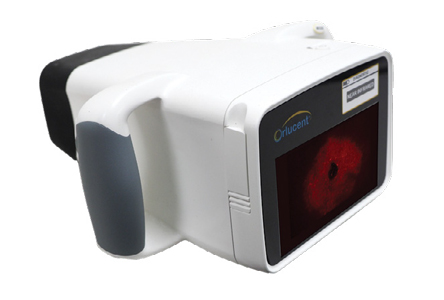 The Orlucent System addresses the gray zone of skin cancer assessment by providing a more precise method for determining when intervention is necessary and when monitoring is appropriate.
“Every biopsy rules something out, but it doesn’t erase the fear that came before it. What physicians need is clarity early, not closure afterward,” says Anne Callahan, clinician relations.
Molecular Clarity at the Point of Care
Orlucent’s first human study generated results that demonstrate clinical potential. The Orlucent System detected melanoma in all confirmed cases while achieving high specificity for benign and low-risk lesions. The trial included common nevi, dysplastic nevi and biopsy-confirmed melanoma, allowing the system to be evaluated across several categories of real-world diagnostics.
The technology quantified varying levels of biological activity in dysplastic nevi, determining that some dysplastic nevi exhibit low activity consistent with benign behavior while others display higher activity associated with elevated risk, suggesting a possible role in identifying moles that may progress. The dataset continues to inform ongoing clinical development and regulatory planning. The findings contributed to the FDA’s Breakthrough Device Designation.
-
A biopsy shouldn’t be the first step forced by a lack of information. It should be the informed step guided by the right information.
Orlucent is pursuing regulatory clearance and conducting additional clinical work to support FDA submission. It anticipates regulatory clearance in the future, based on its current pathway. To ensure The Orlucent System can be used immediately once cleared, Orlucent has already secured a CPT Category III code and developed a reimbursement strategy that includes payer engagement and health-economic modeling.
It is also shaping a practical adoption model through medical education programs, clinical workflow studies and collaboration with dermatology leaders. An advisory board of key opinion leaders continues to guide these plans, ensuring the system integrates naturally into routine care rather than requiring practices to change their workflow.
The Orlucent technology has implications for every part of the care experience. Patients benefit from the possibility of fewer benign biopsies and less uncertainty between visits, without compromising vigilance against melanoma. Health systems and payers are set to see value through improved resource use, with biopsies and surgical interventions aligning more closely with biological risk rather than a precautionary threshold.
The Next Frontier in Early Cancer Detection
While the initial focus is dermatology, the scientific concept extends beyond skin. The system detects biological activity related to stromal remodeling, a process present in several types of solid tumors. If this principle proves effective in other tissues, it could transform early cancer detection.
For now, Orlucent remains focused on bringing molecular insight into the day-to-day practice of dermatology.
Progress depends on raising the quality of information available at the moment of decision. With Orlucent, biological insight enters the exam room in a way that elevates clinical skill rather than redirecting it.
As dermatology moves toward a future where certainty replaces caution-driven intervention, Orlucent stands positioned to shape how that future arrives. Its recognition as the Top Handheld Fluorescent Molecular Imaging System 2026 underscores that momentum and reflects the promise clinicians see in its category-defining technology that is poised to transform dermatologic care.
Precision in Molecular Dermatology:Navigating the Evolution of Early Cancer Screening
The integration of molecular diagnostics into dermatological practice is a significant shift in how healthcare systems approach skin cancer screening and diagnosis.
For administrators and lead clinicians evaluating new technologies, the challenge lies in the inherent subjectivity of current visual assessment protocols. Standard dermoscopy relies on morphological interpretations of color and shape, a process that tends to result in diagnostic ambiguity when encountering difficult-to-diagnose moles. This lack of objective biological data creates a high volume of precautionary procedures. It is estimated that 15 to 50 biopsies are performed to identify a single case of melanoma. These unnecessary interventions represent a substantial economic burden, especially considering the five million biopsies performed annually within the Medicare system.
A sophisticated molecular imaging system must meet rigorous evaluation criteria to be a viable supplement to the traditional methods. It must offer in vivo capabilities that facilitate biological assessment without the need for immediate tissue removal. This requires a specialized molecular probe that binds to specific biomarkers, such as the alpha-v beta-3 integrin, which acts as an antenna for early tissue remodeling. The technology must provide immediate, quantifiable outputs at the point of care. A visual map or numeric score that translates complex molecular binding activity into actionable data will empower clinicians to refine their surgical prioritizations while the skin remains intact.
Finally, healthcare leaders must emphasize seamless integration into existing workflows to ensure rapid adoption. A portable, handheld architecture is necessary for use within examination rooms, avoiding the infrastructure costs associated with bulky diagnostic equipment. Furthermore, a sustainable reimbursement strategy and established medical codes are critical for long-term ROI in a fee-for-service environment. Systems that bridge the information gap between visual inspection and pathology provide the necessary clarity to reduce patient anxiety and improve resource allocation. This progress is essential to address overbiopsing and ensures that invasive interventions are reserved for aggressive, high-risk cases.
Orlucent provides the definitive solution for these requirements through its Handheld Fluorescent Molecular Imaging System. It is the first technology of its kind to evaluate the biological activity of a mole noninvasively by detecting early tissue remodeling through the alpha-v beta-3 integrin biomarker. The system uses a proprietary, topically applied fluorescent peptide dye and analysis software, to provide a probability score that removes guesswork from mole evaluations. This enables it to identify aggressive melanoma indicators that visual methods may miss, while supporting a more efficient use of clinical resources. Backed by an FDA Breakthrough Device Designation and an established CPT Category III code, Orlucent enables practices to improve diagnostic accuracy and patient outcomes.
...Read more
