


Thank you for Subscribing to Med Tech Business Review Weekly Brief


Selecting a CDMO for Scalable Medical Device Production
A medical device can perform well in prototype form yet become expensive to industrialize once design assumptions meet tooling and assembly constraints. The risk is sharper for microfluidic cartridges and point-of-care devices, where fine features, controlled bonding, reagent handling and inspection must remain repeatable at higher volumes. A sourcing decision made too late can leave the manufacturer coordinating several specialist shops while absorbing longer feedback loops and more process variation. CDMO selection should therefore begin with how much manufacturing complexity the partner can absorb before commercial production begins.
Early engineering involvement matters because manufacturability decisions become harder to reverse after tooling and validation work is established. A useful CDMO should be able to review a working prototype for repeatable production, then map how the process can mature as demand increases. That continuity also preserves design history. When the same manufacturing team understands why earlier decisions were made, later troubleshooting does not begin from a cold handoff. Buyers should examine whether development work can move naturally into pilot production and then higher volumes without forcing another transfer between suppliers.
Process ownership becomes equally important when a device depends on several fabrication steps. Injection molding may sit beside laser processing, die cutting, bonding and reagent dispensing, making coordination part of the manufacturing problem rather than a purchasing detail. Outsourcing every specialist step can add queue time and slow changes when tooling or an assembly method needs revision. Greater in-house coverage gives the CDMO more direct control over scheduling and process changes. It can also make cost reduction more practical because engineering decisions are evaluated against the production methods that will actually be used.
Scale should be judged by more than installed machine count. Medical device programs often move unevenly from prototypes to small batches before demand justifies semi-automated or fully automated assembly. A CDMO needs enough capacity to absorb that progression while maintaining documented quality controls and appropriate manufacturing environments. Cleanroom access may be central for one program, while reagent work can introduce different facility requirements. The buyer should also look at inspection throughput. Production expansion loses much of its value if measurement and release become the new bottleneck.
“Hochuen Medical keeps core work such as mold making and injection molding in-house, while extending into laser processing, bonding, reagent handling and assembly.”
Commercial terms deserve the same scrutiny. Low quoted unit cost is less persuasive if the program requires repeated supplier transfers or fresh process development at each volume step. A stronger model connects early design for manufacturability to the automation path, with tooling chosen for that progression. That connection lets unit-cost targets be tested against the process changes required to reach them. Communication structure matters here. Frequent engineering access and direct visibility into manufacturing issues can shorten decision cycles when changes are still inexpensive to make.
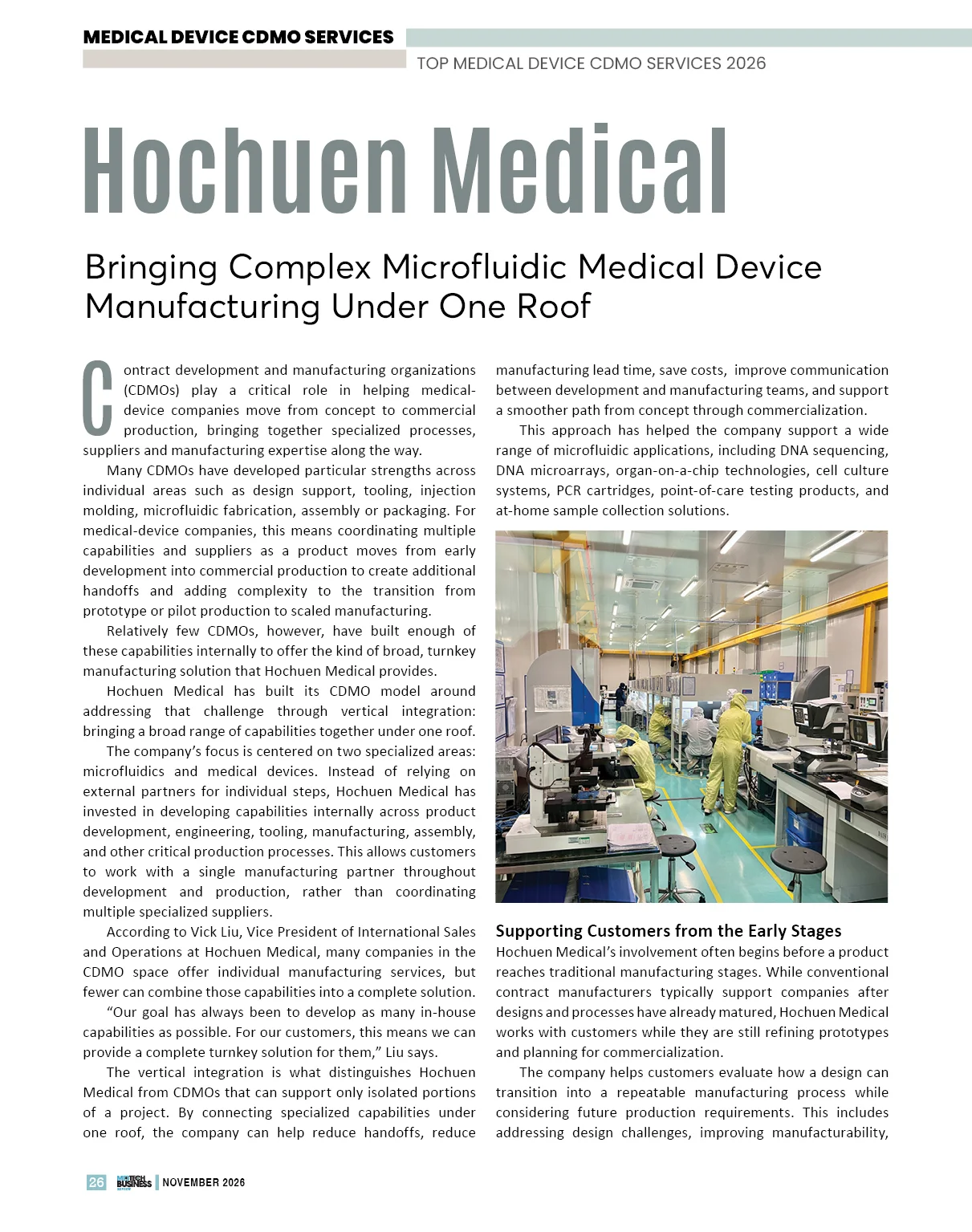
Hochuen Medical fits this buying profile because its model spans product development through low- and high-volume manufacturing, rather than entering only after a process is mature. It keeps core work such as mold making and injection molding in-house, while extending into laser processing, bonding, reagent handling and assembly. Its FDA-registered, ISO 13485-certified facilities include cleanroom and GMP production, supporting devices that need controlled manufacturing environments. The company also plans scale from early DFM through automation as volume rises. For buyers that want fewer manufacturing handoffs without giving up early-stage engineering involvement, Hochuen Medical is a well-matched CDMO choice.
...Read more
Medical Device CDMO Services Info
Q1
What Do Medical Device CDMO Services Include?
Medical Device CDMO Services can cover development, engineering, tooling, manufacturing, assembly and packaging needed to move a device from early design to commercial production. The scope can also include specialized processes such as microfluidic fabrication, molding, bonding, reagent handling and dispensing. For complex products, having several capabilities within one manufacturing model can reduce handoffs and simplify coordination across development stages.
Q2
How Does Hochuen Medical Support The Category?
Hochuen Medical supports Medical Device CDMO Services through a vertically integrated model focused on microfluidics and medical devices. It has built internal capabilities across product development, engineering, tooling, manufacturing and assembly, allowing customers to work with one manufacturing partner. Its capabilities include high-precision injection molding, LSR molding, laser cutting, thin-film die cutting, microfluidic bonding, reagent formulation and packaging. This structure is designed to connect development decisions with later production requirements.
Q3
Why Does Early Development Support Matter?
Early involvement can help connect product design with repeatable manufacturing. Medical Device CDMO Services can support teams while prototypes are still being refined by reviewing manufacturability, addressing design challenges and planning automation for higher volumes. This approach can also preserve product knowledge as development progresses, which may help when later design changes or manufacturing improvements are needed. Early input can therefore help identify production constraints before they become larger development issues.
Q4
Which Capabilities Matter When Choosing A CDMO?
The right Medical Device CDMO Services partner should have capabilities that match the device’s technical and production needs. Precision processes, material integration, specialized bonding, reagent handling and packaging can matter for microfluidic and diagnostic products. Manufacturing controls are also important. Hochuen Medical operates FDA-registered and ISO 13485-certified facilities with cleanroom and GMP capabilities, supporting production where controlled environments are required. These factors can help organizations assess whether a partner can support technical requirements, production conditions, quality controls and the transition to repeatable manufacturing.
Q5
How Can These Services Reduce Manufacturing Complexity?
Medical Device CDMO Services can reduce complexity by bringing related development and production activities together. Instead of coordinating separate suppliers for tooling, molding, assembly or other processes, an integrated partner can connect these stages within one workflow. Hochuen Medical has also developed its own tool shop, with reported prototype injection mold lead times of 2–3 weeks and production mold lead times of 4–6 weeks. Internal tooling can give a manufacturer greater control over timing, design changes and production planning.
Q6
What Role Does Hochuen Medical Play Across The Production Journey?
Hochuen Medical applies Medical Device CDMO Services from early product refinement through manufacturing and commercialization support. Its teams include project managers, engineers and business representatives who work with customers during development and production. The company supports applications including DNA sequencing, DNA microarrays, organ-on-a-chip technologies, cell culture systems, PCR cartridges, point-of-care testing products and at-home sample collection solutions. Its facilities and integrated processes provide a manufacturing base for products requiring specialized microfluidic and diagnostic capabilities, while its broader in-house model supports continuity across development, tooling, production and commercialization planning.
