

Thank you for Subscribing to Med Tech Business Review Weekly Brief


What risks arise when medical device compliance planning begins too late during development?
Compliance Starts Earlier Than Many Companies Think
A medical device can be well designed, clinically valuable, and commercially promising—and still lose months because compliance was treated as something to address near the finish line.
F2 Labs sees that challenge often. By the time a product reaches formal testing, many important choices have already been made. Components are selected. Printed circuit boards are laid out. Software is written around specific hardware. Documentation has taken shape. Market plans may already include FDA submission, CE marking, Nationally Recognized Test Lab (NRTL) certification, Standards Council of Canada (SCC) requirements, or international approvals.
If one of those early decisions does not align with the product’s regulatory path, the consequences can be expensive.
For Wendy Fuster, president of F2 Labs, that is why the relationship between a manufacturer and its testing lab should begin before the product is locked in.
“Before starting medical device compliance testing, I wish every manufacturer understood that they should take the time to get to know their lab,” says Fuster. “That early experience is often a strong indicator of the communication, partnership, and commitment they can expect throughout the project.”
F2 Labs combines technical testing expertise with a service-first approach rooted in integrity, accessibility, and a commitment to doing the right thing for clients. Those values are not just part of the company’s story—they shape the way F2 Labs helps manufacturers identify risks, ask better questions, and avoid surprises before they become costly setbacks.
How do early component decisions influence medical device testing scope and regulatory approval timelines?
The Cost of Finding Out Too Late
One of the most common mistakes F2 Labs sees is not a lack of effort or care—it is timing.
Manufacturers often wait to involve a compliance partner until the design is already far along. By then, they may be committed to a component, material, enclosure, construction method, or product feature that is difficult to change. What might have been a straightforward conversation during development can become a costly issue once the device has been built around that decision.
Wireless radio modules are a clear example. A manufacturer may select a module because it performs well, is readily available, or fits the engineering needs of the device. But the right part from a design perspective is not always the right part from a regulatory perspective. Its approvals may not cover the intended use. It may not support the target markets. It may create additional testing obligations that the manufacturer did not anticipate or budget for.
“When we review a design early, we are not just looking at whether a component works,” says Fuster. “We are looking at whether it works for the way the client plans to use the device and the markets they want to enter. A wireless module may seem like a small design choice, but if it is not approved for that application, it can change the cost, testing scope, and timeline of the entire project.”
The problem becomes harder to solve the later it is discovered. If PCBAs have already been laid out and software has been written around the selected module, replacing it may be impractical. The manufacturer may instead need to add wireless certification testing to the scope of work, increasing cost and extending the timeline.
F2 Labs’ goal is to help clients find those issues while they are still manageable.
“Early compliance guidance can prevent unnecessary testing, reduce the risk of redesign, and help keep the project moving toward approval more efficiently,” Fuster says.
Why is accurate compliance scoping important for coordinated medical device testing and documentation?
A Fuller Picture from the First Conversation
When prospective clients first contact F2 Labs, their concerns usually fall into a few familiar categories. Many are worried about timeline and cost. Others are trying to understand which standards apply, what the FDA may expect, or whether their product is ready for EMC, electrical safety, wireless, environmental, or other testing. Some need support for CE marking, NRTL certification, SCC requirements, FDA 510(k) submissions, international approvals, or simply a clearer understanding of what comes next.
Sometimes clients know exactly what they want to ask for. Other times, they know the outcome they need but not the full path to get there.
F2 Labs begins by looking beyond the initial request to understand what the product is truly likely to require. That distinction is critical. Medical device compliance rarely depends on one isolated test. Requirements can overlap depending on the device’s intended use, construction, power source, wireless functionality, target markets, and documentation.
-
Before starting medical device compliance testing, every manufacturer should take the time to get to know their lab. That early experience is often a strong indicator of the communication, partnership and commitment they can expect throughout the project.
That is also why quotes from different labs can be difficult to compare. A lower quote may not represent a more efficient path—it may simply leave out work the manufacturer will eventually need.
“Comparing lab quotes can be a little like comparing construction bids,” says Fuster. “One proposal may look lower because it only includes the rooms you asked about, while another includes the foundation, electrical, plumbing, and inspections needed to actually finish the building. Clients deserve to know what is in the scope, what is not, and what questions may come up later.”
That approach is not always the easiest from a sales perspective. It can require F2 Labs to raise issues a prospective client was not expecting. It can also mean explaining why a complete path may look different from a narrower proposal.
But for F2 Labs, honest scoping is part of responsible service. The company would rather have the hard conversation early than let a client discover later that the original plan did not account for everything the product needed.
This mindset is especially important for medical devices evaluated to standards such as IEC 60601-1, IEC 60601-1-2, and other 60601-series requirements. In those projects, product construction, electromagnetic compatibility, labeling, documentation, and risk considerations all need to work together. The device is not simply tested in pieces—the pieces have to make sense as a whole.
What Manufacturers Often Do Not Realize
From the outside, testing can appear linear. A company sends a device to the lab, the lab performs the required evaluations, and a final report follows.
The reality is usually more involved.
Questions come up. Documentation needs clarification. Construction details must be verified. Product changes need to be communicated. A test result may require discussion before the next step is clear. Progress depends not only on the lab’s technical capability, but also on the quality of communication between the lab and the manufacturer.
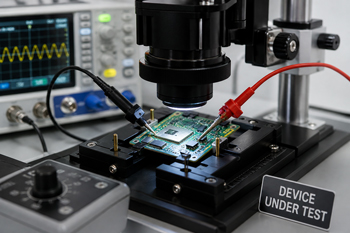 “Testing is not a black box where a product goes in and a report comes out,” says Fuster. “It is a process that works best when the manufacturer and the lab stay engaged with each other. The faster we can get accurate information, clarify changes, and resolve questions, the more efficiently the project can move.”
The most successful projects are often the ones where the manufacturer stays responsive and transparent throughout the process. Compliance is not just about passing a test—it is about making sure the product, documentation, labeling, construction, and applicable standards all line up correctly.
Rushing does not necessarily make that happen faster.
“Trying to rush the process can actually slow it down,” says Fuster. “Skipping steps, sending incomplete information, making changes without communicating them, or pushing for answers before the lab has what it needs can create delays. The fastest path is usually not to force the process—it is to support it with clear communication, complete information, and timely responses.”
That practical guidance is part of what clients receive when they work with F2 Labs. The company provides testing, but it also helps manufacturers understand what the process requires of them. For startups and growing medical device companies without large internal regulatory teams, that kind of guidance can be just as important as the testing itself.
To what extent does integrated testing improve coordination across medical device compliance requirements?
Integrated Testing, Grounded in Service
F2 Labs supports medical device manufacturers across a wide range of compliance needs, including EMC, electrical safety, wireless, environmental testing, NRTL certification, CE marking, SCC requirements, FDA 510(k) support, FDA ASCA laboratory services, and international approvals.
Having those capabilities under one roof gives the team a broader view of each project. A connected medical device, for example, may need electrical safety testing, EMC evaluation, wireless review, and documentation support for regulatory submission. Those requirements are connected. A change that helps in one area may raise a question in another, and a decision that seems minor during design can affect the final approval path.
F2 Labs helps clients see those connections earlier.
The company’s integrated model is not just about convenience—it reduces the risk that important details will be lost between separate vendors, disconnected scopes, or isolated test events. When engineers and compliance specialists can evaluate the full project together, clients receive clearer guidance and a more coordinated path forward.
“Clients do not benefit when every requirement is treated like a separate checkpoint,” says Fuster. “They benefit when someone is looking at how those requirements interact and helping them understand what each decision means for the larger project.”
For prospective clients, the early conversations with a lab matter. They reveal whether the lab is asking thoughtful questions, whether the team is willing to explain requirements clearly, and whether potential problems will be raised early enough to do something about them.
A lab’s accreditations and capabilities are essential. But the client experience also depends on something less easily captured in a scope of work: communication, accountability, and commitment.
That is where F2 Labs continues to distinguish itself.
Medical device manufacturers are trying to bring meaningful products to market in an environment where timelines are tight, requirements are demanding, and late-stage surprises can be costly. F2 Labs helps make that path clearer. By engaging early, asking better questions, and helping clients understand the full scope of what their products may require, the company turns compliance from a final hurdle into a smarter path to market.
“Compliance is not just about testing a product,” says Fuster. “It is about making sure the product, documentation, labeling, construction, and applicable standards all line up correctly. When that happens, manufacturers are in a much stronger position to move forward.”
Coordinating Certification Pathways in Medical Product Testing
Medical product compliance and certification testing has shifted from a checkpoint exercise to a program that directly influences time to market, cost control and regulatory confidence. For executives responsible for bringing devices through approval, the challenge rarely lies in meeting a single standard. Complexity emerges when safety, electromagnetic compatibility, wireless performance and regional regulatory expectations intersect, often in ways that create unintended dependencies. Fragmented testing models, where each requirement is handled in isolation, tend to introduce translation gaps, duplicated effort and late-stage failures that force redesign cycles.
A more effective approach begins with how the compliance pathway is structured before formal testing starts. Programs that map product architecture, intended markets and applicable standards early tend to surface interactions that would otherwise remain hidden. Design decisions made for safety can influence emissions behavior, while wireless configurations may affect both immunity performance and regulatory labeling. When these relationships are understood upfront, testing workflows can be sequenced intelligently, reducing the risk that a successful result in one area triggers a failure in another. The outcome is not just efficiency but predictability.
Execution capability also plays a defining role. Laboratories which rely heavily on external partners for different disciplines often introduce delays that stem from fragmented visibility. A connected device evaluated across multiple providers requires coordination not only of test schedules but of interpretations and corrective actions. Integrated laboratory environments, where safety, EMC and wireless evaluations are conducted within a coordinated framework, allow engineers to collaborate in real time, compare results directly and guide corrective actions without waiting for cross-vendor alignment. This reduces iteration cycles and supports faster movement from issue identification to resolution.
Regulatory evolution adds another layer of complexity. Standards change, regional requirements shift and accreditation expectations continue to evolve. Programs that treat these changes as isolated updates often disrupt active projects or introduce uncertainty for submissions already in progress. A disciplined approach monitors regulatory developments continuously and applies updates based on their actual impact, allowing compliance programs to adapt without unnecessary interruption.
The greatest gains in compliance efficiency often occur before formal testing begins. Early engagement, where assumptions are tested and documentation is reviewed against applicable standards, can prevent issues that would otherwise emerge during certification. Identifying gaps in documentation, inconsistencies in labeling, or misalignment between intended use and test requirements reduces the likelihood of costly rework. When issues arise during testing, the ability to interpret results in context and guide corrective actions quickly becomes critical.
F2 Labs exemplifies this integrated model by treating compliance as a coordinated certification pathway rather than a series of isolated tests. It aligns safety, EMC, wireless and regulatory requirements within a single program, allowing clients to move from early evaluation through final approvals with continuity and clarity. Its in-house capabilities enable cross-disciplinary collaboration, reducing reliance on external providers and shortening feedback loops. It also applies a structured approach to regulatory change, helping clients understand what shifts matter and how to respond without disrupting ongoing work.
The combination of integrated execution, early-stage alignment and continuous regulatory awareness positions F2 Labs as a strong choice for organizations that need a more predictable and coordinated path to certification.
...Read more
Insights
Beyond Passing the Standard: What FDA Reviewers Are Looking for in Medical Device EMC Submissions
Wendy Fuster, President A discussion about intended environments at the start of the project usually identifies these issues before they become a regulatory delay.

Medical Product Compliance and Certification Testing Labs Info
Q1
What Should Buyers Expect from Medical Product Compliance & Certification Testing Labs?
Manufacturers need more than a basic pass-or-fail answer. Medical Product Compliance & Certification Testing Labs should help prove that a device is safe, reliable and ready for regulatory review. F2 Labs supports that process with IEC 60601-1 safety testing, IEC 60601-1-2 EMC testing, ISO 14971-aligned risk support, IP and environmental testing along with wireless and RF testing for connected care devices. The real value is having testing and documentation come together in a way that makes submissions cleaner and easier to defend.
Q2
How Does F2 Labs Support Medical Device Readiness?
F2 Labs helps manufacturers prepare for regulatory review by combining testing with practical documentation support. Its services include FDA ASCA summary reports for EMC and electrical safety, wireless coexistence reviews, electromagnetic emitter testing, pre-testing and early design reviews. That matters because Medical Product Compliance & Certification Testing Labs are often involved while product design and submission planning are still taking shape. Finding issues early can save time, money and unnecessary redesign work later.
Q3
Why Do EMC and Wireless Reviews Matter for Connected Products?
A connected device can perform well during development and still run into problems once it is surrounded by monitors, pumps, Wi-Fi networks or mobile phones in real healthcare settings. Medical Product Compliance & Certification Testing Labs help manufacturers confirm that wireless functions and electromagnetic immunity remain stable under those everyday conditions. The benefit is straightforward: fewer surprises during review, fewer redesigns and more confidence before products reach hospitals, homes or transport environments.
Q4
What Should a Testing Report Prove for Regulatory Review?
A strong testing report should clearly explain what was tested, which standards applied, how the device performed and where any limitations appeared. Medical Product Compliance & Certification Testing Labs become far more useful when reports are detailed enough for engineering, quality and regulatory teams to work from without rebuilding the evidence trail themselves. F2 Labs supports FDA and EU-aligned submissions with reporting tied to recognized testing programs. At some stage reviewers will want to know exactly how every conclusion was reached.
Q5
How Should Manufacturers Evaluate Lab Accreditation?
Accreditation should match the actual testing requirements of the device rather than act as a general badge of credibility. Medical Product Compliance & Certification Testing Labs should show relevant scope for electrical safety, EMC, wireless approvals and market-specific requirements. F2 Labs operates three U.S. testing laboratories and lists A2LA, ASCA, FCC and ISED accreditations along with ISO/IEC 17025 accreditation through A2LA. Manufacturers should compare that scope directly against the standards their products need to meet.
Q6
What Makes Testing Valuable Before Final Certification?
Early testing often uncovers weak documentation, unrealistic setups, design risks or wireless assumptions before formal submission timelines begin. Medical Product Compliance & Certification Testing Labs are most valuable when they help manufacturers spot those gaps while changes can still be made efficiently. Pre-testing and design review support can turn compliance from a stressful late-stage hurdle into a smoother part of product development.
