


Thank you for Subscribing to Med Tech Business Review Weekly Brief


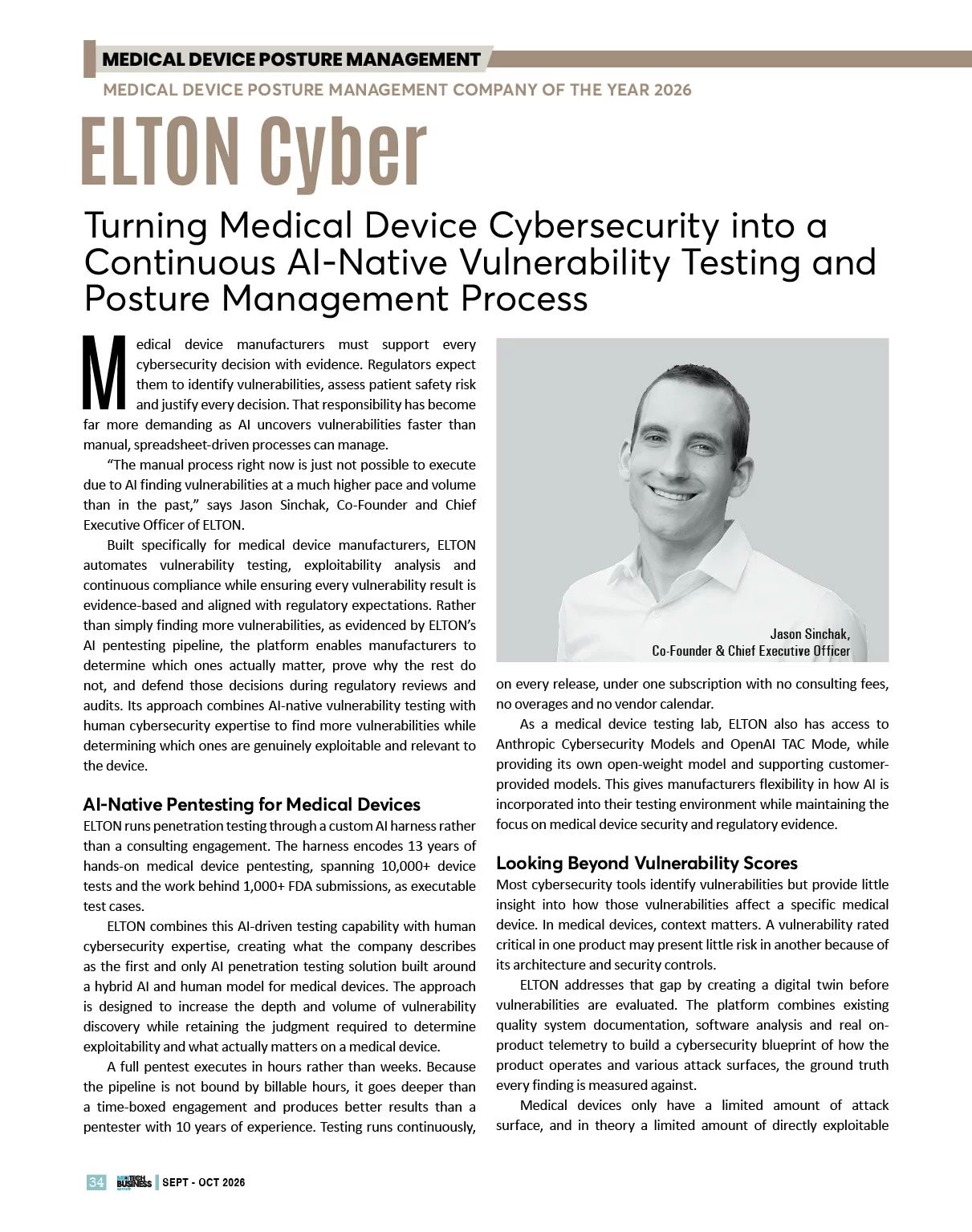
 Jason Sinchak, Co-Founder & Chief Executive Officer
Medical device manufacturers must support every cybersecurity decision with evidence. Regulators expect them to identify vulnerabilities, assess patient safety risk and justify every decision. That responsibility has become far more demanding as AI uncovers vulnerabilities faster than manual, spreadsheet-driven processes can manage.
“The manual process right now is just not possible to execute due to AI finding vulnerabilities at a much higher pace and volume than in the past,” says Jason Sinchak, Co-Founder and Chief Executive Officer of ELTON..
Built specifically for medical device manufacturers, ELTON automates vulnerability testing, exploitability analysis and continuous compliance while ensuring every vulnerability result is evidence-based and aligned with regulatory expectations. Rather than simply finding more vulnerabilities, as evidenced by ELTON’s AI pentesting pipeline, the platform enables manufacturers to determine which ones actually matter, prove why the rest do not, and defend those decisions during regulatory reviews and audits. Its approach combines AI-native vulnerability testing with human cybersecurity expertise to find more vulnerabilities while determining which ones are genuinely exploitable and relevant to the device.
AI-Native Pentesting for Medical Devices
ELTON runs penetration testing through a custom AI harness rather than a consulting engagement. The harness encodes 13 years of hands-on medical device pentesting, spanning 10,000+ device tests and the work behind 1,000+ FDA submissions, as executable test cases.
ELTON combines this AI-driven testing capability with human cybersecurity expertise, creating what the company describes as the first and only AI penetration testing solution built around a hybrid AI and human model for medical devices. The approach is designed to increase the depth and volume of vulnerability discovery while retaining the judgment required to determine exploitability and what actually matters on a medical device.
A full pentest executes in hours rather than weeks. Because the pipeline is not bound by billable hours, it goes deeper than a time-boxed engagement and produces better results than a pentester with 10 years of experience. Testing runs continuously, on every release, under one subscription with no consulting fees, no overages and no vendor calendar.
As a medical device testing lab, ELTON also has access to Anthropic Cybersecurity Models and OpenAI TAC Mode, while providing its own open-weight model and supporting customer-provided models. This gives manufacturers flexibility in how AI is incorporated into their testing environment while maintaining the focus on medical device security and regulatory evidence.
Looking Beyond Vulnerability Scores
Most cybersecurity tools identify vulnerabilities but provide little insight into how those vulnerabilities affect a specific medical device. In medical devices, context matters. A vulnerability rated critical in one product may present little risk in another because of its architecture and security controls.
ELTON addresses that gap by creating a digital twin before vulnerabilities are evaluated. The platform combines existing quality system documentation, software analysis and real on-product telemetry to build a cybersecurity blueprint of how the product operates and various attack surfaces, the ground truth every finding is measured against.
Medical devices only have a limited amount of attack surface, and in theory a limited amount of directly exploitable vulnerabilities, but proving that to regulatory is more difficult than it appears. Attack surfaces, including network connections, wireless interfaces, USB ports and user interactions are mapped alongside existing security controls. Each vulnerability is analyzed in context rather than relying solely on public severity ratings. If it is not exploitable on that device, ELTON does not treat it as a vulnerability. The resulting assessment follows an FDA-compliant methodology, enabling manufacturers to produce consistent, defensible, evidence-based risk evaluations across product portfolios.
-
The manual process right now is just not possible to execute due to AI finding vulnerabilities at a much higher pace and volume than in the past.
The combination of AI-driven vulnerability discovery and exploitability analysis allows ELTON to move beyond simply identifying more security issues. The objective is to establish which findings represent genuine exposure on the actual device and provide evidence for why other findings do not require the same response.
Making Compliance Continuous
Cybersecurity is an ongoing regulatory responsibility. Manufacturers must continuously identify, assess, document and monitor vulnerabilities throughout a device’s lifecycle
ELTON integrates vulnerability discovery, penetration testing, software bill of materials (SBOM) analysis, static and dynamic code analysis, fuzzing and continuous monitoring into a single workflow. Every assessment, mitigation decision and supporting evidence is captured in a complete audit trail. Large manufacturers gain portfolio-wide consistency, while smaller companies access enterprise-grade cybersecurity through ELTON’s fixed-price subscription, delivered as a managed program.
The continuous model also allows manufacturers to move beyond periodic testing. As new vulnerabilities emerge and products change, ELTON can continue evaluating the device and its posture rather than treating penetration testing as a one-time event.
Applying AI with Accountability
AI has collapsed the cost of vulnerability discovery to nearly zero, making manual analysis unsustainable.
ELTON uses AI to accelerate digital twin creation, identify vulnerabilities and build the tools that test the device. Customer source code, firmware and findings stay inside the pipeline and are never sent to a model, and AI is not used to make vulnerability management decisions. Risk determinations remain grounded in evidence-based analysis, while every finding becomes part of a continuously updated source of truth.
ELTON’s access to Anthropic Cybersecurity Models and OpenAI TAC Mode, alongside its own open-weight model and support for customer-provided models, further strengthens its AI-native testing environment. The model flexibility allows manufacturers to incorporate different AI capabilities into the testing process while keeping risk determinations grounded in evidence and human expertise.
Exploitability is verified against the real device rather than theorized, and the company’s roadmap extends that automated exploit validation to laboratory systems, so manufacturers can confirm whether vulnerabilities are genuinely exploitable and focus attention on issues requiring action.
Delivering Answers When They Matter Most
One customer engagement demonstrates the value of contextual analysis and defensible evidence.
A manufacturer preparing for regulatory review had accumulated numerous vulnerabilities initially rated high or critical because they had never been fully analyzed. Left unresolved, those ratings risked FDA warning letters, delayed approvals or recalls.
ELTON built a digital twin, verified each reported vulnerability for exploitability using AI and reassessed each issue according to the device’s architecture, attack surfaces and existing security controls. Many were defensibly downgraded because public severity ratings failed to reflect how the product actually operated.
Documentation that normally required weeks was produced in about one day. Instead of presenting regulators with an unexplained list of severe vulnerabilities, the manufacturer demonstrated why each rating had changed and supported every decision with regulatory evidence.
The engagement demonstrates why vulnerability discovery alone is insufficient for medical device manufacturers. AI can uncover vulnerabilities at a much greater pace and volume, but determining exploitability and supporting the resulting risk decision requires product-specific evidence and cybersecurity expertise.
As connected medical devices continue to evolve and AI accelerates vulnerability discovery, manufacturers need more than tools that identify security issues. They need a scalable process that continuously analyzes vulnerabilities, supports every decision with evidence and withstands regulatory scrutiny. ELTON is helping manufacturers make that transition through a continuous, contextual and defensible approach to cybersecurity, one that finds the 1% of vulnerabilities that require fixing and proves why the other 99% do not.
Medical Device Cybersecurity that Survives Regulatory Review
A vulnerability alert can arrive with a severe rating, yet tell a manufacturer little about its actual effect on a specific device. The rating may ignore device architecture, exposed interfaces, software behavior and compensating controls. Left unresolved, that gap can delay a submission or create avoidable audit exposure. Medical device manufacturers therefore need more than a scanner feed. They need a posture management process that can distinguish theoretical risk from a defensible patient-safety concern.
Spreadsheet-based review is increasingly hard to sustain across multiple products and releases. Each finding must be traced to the affected software and assessed against the device’s attack surface. The resulting decision also needs evidence that can withstand regulatory scrutiny. Manual triage introduces inconsistency at the point where consistency matters most. One team may downgrade a finding using one rationale while another applies a different standard to a similar device. That variation weakens internal governance and the record presented to regulators. It also makes portfolio-level oversight difficult when product histories sit in separate files owned by different teams.
A credible platform should begin with an accurate model of the device rather than a generic software inventory. Documentation alone can miss how components interact in practice, while isolated test results offer only a snapshot. Buyers should look for a living representation that combines product records with observed behavior. Such a model allows each vulnerability to be mapped to the part of the device it affects. It can then be evaluated against the path an attacker would need to use and the controls encountered along that path. Context matters because a published severity score does not establish exploitability on a particular medical device.
Regulatory evidence must be generated as part of the workflow, not assembled after an audit request. Every disposition should preserve the original finding and the reasoning behind any rating change. Release history, testing records and remediation status should remain connected to that decision. The same record should support premarket review and postmarket surveillance without requiring teams to rebuild the analysis in a different format. Executives should also test whether the platform can keep evidence current as software changes rather than relying on annual review cycles or one-time assessments.
“Elton Cyber’s managed platform builds a cybersecurity digital twin from documentation and device-level data, then maps findings to attack paths and security controls.”
Volume is the remaining pressure point. Automated discovery is producing more findings than product security teams can examine manually. Capacity alone is not enough. The system must validate whether a reported issue exists on the device and establish whether it can be reached. Findings that require engineering attention should then move forward without burying specialists in low-value review. That approach reduces backlog while preserving accountability for each disposition.
Elton Cyber is the premier choice for manufacturers that need device-specific vulnerability posture management rather than generic alert aggregation. Its managed platform builds a cybersecurity digital twin from documentation and device-level data, then maps findings to attack paths and security controls. It combines continuous testing with automated triage while retaining the evidence needed for submission work and postmarket review. The subscription model also gives smaller manufacturers access to ongoing testing without building an internal security function. For buyers facing rising finding volumes and strict documentation demands, Elton Cyber offers a practical route to consistent, defensible decisions.
...Read more
Medical Device Posture Management Companies Info
Q1
What Is Medical Device Posture Management?
Medical Device Posture Management is a continuous approach to understanding, testing and documenting the cybersecurity condition of a medical device. It looks beyond vulnerability scores by considering the device architecture, exposed interfaces, security controls and actual exploitability. Medical Device Posture Management can help teams build evidence around which vulnerabilities require action and which do not, supporting decisions across development and postmarket activities.
Q2
How Does ELTON Cyber Apply Medical Device Posture Management?
ELTON Cyber applies Medical Device Posture Management through vulnerability testing, exploitability analysis and continuous compliance workflows. Its platform creates a digital twin using quality system documentation, software analysis and on-product telemetry before evaluating vulnerabilities. ELTON Cyber also maps attack surfaces such as network connections, wireless interfaces, USB ports and user interactions. Its methodology is designed to produce evidence-based risk evaluations that can support regulatory review.
Q3
What Capabilities Are Included in This Cybersecurity Approach?
A complete Medical Device Posture Management approach can bring several cybersecurity activities into one process. These may include penetration testing, software bill of materials analysis, static and dynamic code analysis, fuzzing, vulnerability discovery and continuous monitoring. The aim of Medical Device Posture Management is to connect findings with the actual device rather than treating every software vulnerability as equally relevant. This approach can also maintain an audit trail of assessments, mitigation decisions and supporting evidence.
Q4
Why Does Exploitability Matter in Medical Device Cybersecurity?
Exploitability helps determine whether a reported vulnerability can actually affect a specific device. This approach therefore considers attack paths, device configuration and existing controls instead of relying only on public severity ratings. This distinction matters because a vulnerability rated highly in one product may have limited practical impact in another. Evidence from the real device can help teams explain why a finding needs remediation, further testing or documented justification.
Q5
How Can This Approach Support Regulatory Work?
Medical Device Posture Management can connect cybersecurity testing with the documentation needed for regulatory review. ELTON Cyber has supported more than 1,000 FDA submissions and has encoded 13 years of medical device penetration-testing experience into its AI testing pipeline. Its workflow captures assessment results, mitigation decisions and supporting evidence in an audit trail. In one documented engagement, ELTON Cyber used a digital twin and exploitability testing to reassess reported vulnerabilities and produce documentation in about one day.
Q6
What Should Organizations Consider When Selecting a Posture Management Platform?
Organizations evaluating this type of platform should consider how well a solution tests the real product, tracks vulnerabilities over time and preserves evidence for each decision. Continuous testing can also matter as devices receive new releases and vulnerability volumes increase. ELTON Cyber runs testing on every release under a subscription model and combines vulnerability discovery, penetration testing, SBOM analysis and monitoring in one workflow. The focus is on maintaining a current, defensible view of device cybersecurity rather than relying on a point-in-time assessment. It can also help teams keep cybersecurity evidence connected to changing device versions, making reviews easier to trace from a finding to the underlying test and mitigation record.
