

Thank you for Subscribing to Med Tech Business Review Weekly Brief
MedTech Business Review: Specials Magazine
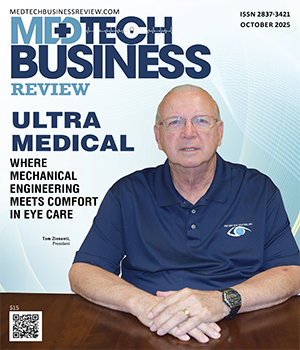
“Boy, I wish I had something to do this.” To most, it’s a sigh of vexation. To Tom Zinnanti, president of Ultra Medical, formerly The Dry Eye Doctor, it sparks invention. A mechanical engineer by training, Zinnanti has spent over 40 years turning offhand physician comments like that into precision instruments that make procedures easier for doctors, safer for patients and faster for hospitals and clinics worldwide. His career began in gynecology, plastic surgery and podiatry before moving into ophthalmology and optometry, where his innovations now address one of the fastest-growing conditions in modern medicine—dry eye disease. Whether developing meibomian gland expressors, punctal plug forceps or the ULTRA Pro Moist Heat Dry Eye Compress, Zinnanti works from a single principle: listen to what doctors need and build it better. “I don’t believe in distributing off-the-shelf tools,” Zinnanti says. “Every doctor’s needs are different and every patient is different. That’s why we design with both in mind. I sketch ideas, send drawings to manufacturers in Germany known for producing high-quality instruments, review prototypes and refine them in collaboration with clinicians.” That philosophy shows up in every product. The ULTRA Pro Moist Heat Dry Eye Compress, for example, takes only 20 seconds in a microwave to deliver steady warmth that lasts nearly ten minutes. For patients, it melts the solidified oils that block the meibomian glands, offering quick relief. For physicians, it means easier expression, less chair time and gentler procedure for both sides of the exam lamp. Same approach guided the Meibomian Gland Expressor. Earlier versions forced doctors to juggle paddles, fingers and slit lamps at awkward angles. Zinnanti reimagined it as a tweezer with angled paddles, freeing up hands and improving visibility. What was once cumbersome became one smooth, efficient motion; faster for doctors, more comfortable for patients. Safety inspired a redesign of therapeutic lens instruments. Removing a Prokera lens once meant sharp jeweler’s forceps near the cornea, a risk no doctor wanted to take. Zinnanti’s rounded design grips and releases without danger, so effectively that the manufacturer now ships his tool with every lens. A similar idea shaped the amniotic membrane forceps, which have flat-closing jaws that prevent punctures and a looped tip that smooths the delicate tissue into place. The gain is twofold: fewer wasted membranes and faster procedures.
Top Orthopedic Medical Equipment Distributor
Vigour Med Store, a trusted medical equipment supplier in Virginia, is redefining how medical equipment, hospital supplies, and laboratory equipment reach the people who need them most. Built on the principles of healthcare equity and operational readiness, the company provides everything from trauma kits and diagnostic devices to mobility aids and durable medical equipment (DME) - with one mission: to make essential medtech accessible, transparent, and reliable so care providers can focus on patients, not procurement. For too long, healthcare providers have faced a broken procurement process—outdated product listings, missing images, vague specifications, slow supplier responses, and inflated prices. At the same time, manufacturers have struggled to reach the hospitals, clinics, EMS teams and local government buyers who depend on their solutions. Vigour Med Store was founded to close these gaps, creating a clear and reliable channel between brands and the frontline providers. As an authorized distributor of more than 300 global brands including 3M and Omron Healthcare. Vigour Med Store ensures consistent availability, accurate product data, and fair pricing. Its reach extends across hospitals, clinics, government contractors, humanitarian organizations, and private practices, enabling them to stay prepared and deliver better care. “We are here to be mission first, not margin first. That commitment is the foundation of our work in healthcare equity.” — Faisal Ghafar, Founder & Chief Strategist Guided by this principle, Vigour Med Store has built a distribution model that reaches every type of buyer. On the institutional side, it supports hospitals, government contractors and clinics through a government-compliant sales team skilled at navigating complex procurement requirements. These teams provide tailored solutions that strengthen improve preparedness. It also has a subscription model in place to reinforce continuity of supply, help institutions avoid stockouts and respond faster in critical situations.

Top Patient Lift Systems 2025

With no-lift policies reshaping patient care, healthcare facilities are under growing pressure to protect both patients and caregivers. The need is especially critical in acute care, where complex, large-scale lifting demands are the norm. Long-term care environments, on the other hand, tilt more toward ongoing safety, comfort, and rehabilitation. Modern lifting solutions address both settings, minimizing the risks of manual transfers while building caregiver confidence. At the forefront of this shift, Tollos delivers smart lifting solutions that help hospitals and caregivers adapt and thrive. While the company serves acute and long-term care, its primary focus is on acute care facilities. Its portfolio spans mobile and ceiling lift systems, slings, and accessories designed to integrate seamlessly into clinical practice. “Durability drives our design, but client needs guide our innovation,” says Jason Treslove, COO. “This duality enables us to build solutions that truly make care safer, smoother, and more human-centered.” The company has built a wide range of solutions for safe patient handling—from basic mobility aids to ergonomically designed equipment—expanding into sit-to-stand and assisted mobility devices that support patients with partial independence. Its portfolio now includes widely adopted ceiling lifts alongside mobile options, all complemented by custom-fit slings that ensure safe, effortless transfers tailored to each patient’s size and comfort. Recognizing that every healthcare environment has distinct needs, Tollos designs user-friendly equipment with smart technology. Its mobile and ceiling lifts feature simple hand controls, intuitive sling attachments, and advanced circuitry with redundant safety systems. These include current limiters to prevent overload, service reminders, and built-in scales for weighing patients during transfers, streamlining tasks for nursing staff and personal support workers. Each installation begins with a detailed walkthrough of the facility to account for layout, patient volumes, and care requirements. Whether it’s linear lift systems or advanced XY configurations that provide complete room coverage with smooth transitions into adjoining spaces, Tollos ensures every specification is implemented with precision. For bariatric care in particular, its ceiling lifts accommodate weights from 450 to 1,000 pounds, giving facilities confidence in their ability to serve diverse patient populations.
Top Precision Calibrations and Biomedical Test Equipment 2025
When lives depend on precision, healthcare facilities can’t rely on just any service provider for device calibrations and testing. They need a partner that keeps them compliant, fully operational and audit-ready. QRS Calibrations LLC (dba QRS Solutions) offers accredited calibrations and biomedical test equipment while helping clinical engineering teams streamline preventive maintenance, manage equipment records and meet regulatory standards. By working directly with biomedical departments, QRS simplifies compliance, reduces downtime and strengthens equipment reliability, making it an indispensable ally in supporting patient safety. “We want a customer for life. We’ve grown through our focus on sustained client success, not one-time sales,” says Karie Heiselt, Manager. This philosophy of long-term commitment defines how QRS engages with clients. It focuses on partnerships that strengthen client teams, extending well beyond the workbench to provide consultative insight, workflow improvements and tailored support that align with each client’s goals. The dedication is rooted in understanding the day-to-day challenges customers face. “It’s really about helping customers when we know they’re being asked to do more with less. Many struggle to bring in additional staff due to budget limitations or the lack of new talent. We step in to support however we can,” says Dave Heiselt, Manager. Precision in Critical Moments The impact of QRS’s approach is evident when circumstances demand swift, flawless execution. One such example comes from a major Southern California hospital system facing a sudden regulatory audit. With calibration records dispersed among several vendors, the facility risked falling short of requirements. QRS responded immediately. Within 10 business days, a dedicated team consolidated, calibrated and documented more than 300 pieces of biomedical equipment. The hospital cleared the audit without any issue and this experience cemented QRS as the facility’s exclusive calibration partner. The company’s ability to manage and maintain equipment records with accuracy and consistency proved more reliable than the client’s internal systems, reinforcing the value of having a single, trusted source for compliance readiness. QRS’s capabilities extend well beyond emergency interventions. NIST-Traceable, ISO 17025:2017 accredited, ANSI/NCSL Z540-1-1994 (R2002) and ISO 9001:2015-certified services, combined with advanced software integrations that connect directly to clients’ computerized maintenance management systems. This streamlines preventive maintenance, ensures accurate documentation and minimizes administrative workload, empowering client teams to stay audit-ready and efficient. “Between the fast turnaround times, highly trained technicians and deep compliance expertise, we’re not just keeping equipment running, we’re ensuring our clients pass audits effortlessly,” says Steve Jansen, Sales Manager. By balancing quick problem-solving with sustainable process improvements, QRS prepares customers for any challenge. Nationwide Reach, Personal Approach To address these diverse needs, QRS maintains a footprint that spans the country with the Mobile Calibrations Vans. It serves clients with Depot Calibrations in California and Texas, with an East Coast hub set to open next year. The company also supports facilities with On-site Service in Alaska and Hawaii, ensuring even the most remote locations have access to specialized expertise. Expansion is carefully paced, with the company growing 10 to 15 percent annually since 2007. To meet rising demand, the process of adding a Mobile Calibration Van to the fleet can be completed within 30 days. Because most work is performed onsite, this mobility minimizes downtime, accelerates service and delivers a personalized experience for every client. The company’s commitment extends beyond technical expertise. Through training sessions, webinars and active participation in regional healthcare technology management associations, QRS strengthens the skills and knowledge of biomedical teams nationwide. These efforts reinforce the company’s position as both a service provider and an industry advocate.

Medical Suppliers and Distributors

A Synopsis of Clinical Engineering/ Biomedical Engineering
Dr. Haniff Murray, Clinical Engineer/Alternate Manager/Researcher, Memorial Healthcare System
Medical Suppliers and Distributors

Electrophysiology at the Core of Next-Gen Eye Care Solutions
Minzhong Yu, Director, Ophthalmic Electrophysiology, Department of Ophthalmology, University Hospitals
Medical Suppliers and Distributors

Driving Excellence in Patient
Patricia Punzalan, Sr. Director for Patient Care Services, Dignity Health
Medical Suppliers and Distributors

Redefining Pharmacy Practice through Innovation and Leadership
Madeline Camejo, Vice President and Chief Pharmacy Officer, Baptist Health
Medical Suppliers and Distributors

Operational Leadership that Keeps People at the Center
Ryan Garland, AVP - Radiology & Respiratory, Endeavor Health

IN MY OPINION
Medical Suppliers and Distributors
Improving and Innovating Quality and Patient Safety
Sharon Gilliam, MSN, RN, Director of Patient Safety & Quality, Williamson Health

LAST WORD
Medical Suppliers and Distributors
Medical Equipment Support Contracts: Creating Your Own Value Equation
Scott Bosch, Director, Clinical Engineering, HealthPartners
IN FOCUS

Driving Vision Care Forward: Market of Ophthalmic Instrument Distribution
The ophthalmic instrument distribution market is rapidly evolving due to technology, rising eye disorders, and increasing demand for vision care.

Invisible Precision: Powering Trust in Medical Device Testing
Advancements in precision calibration and biomedical testing equipment are enhancing healthcare by ensuring device accuracy, improving patient safety, and enabling smart diagnostics through AI and secure technologies.
EDITORIAL
Sharper Tools Better Care
In the United States, MedTech firms working in ophthalmic instrument distribution, precision calibration for biomedical test equipment, patient lift systems, and medical emergency gear are quietly orchestrating the next era of health care. The ophthalmic devices market alone is estimated at $19.3 billion in 2024 and is projected to grow at about 7.7 percent CAGR through 2030.
Distributors must coordinate closely with manufacturers and clinics to manage inventory, logistics, quality control, and rapid servicing for slit lamps, tonometers, and retinal imagers. Precision calibrations and biomedical test equipment form the backbone of trustworthy diagnostics. Aligning voltages in electrophysiology instruments or validating sensitivities in immunoassay analyzers is essential because calibration errors translate directly into wrong diagnoses or missed disease progression.
In ophthalmic electrophysiology, waveform fidelity is vital; even small drift or noise can nullify insights. Patient lift systems are becoming a critical support technology. In North America, patient lifting equipment markets surpassed $2.45 billion in 2024 with roughly 36 percent of global share and are forecast to grow steadily.
Powered and overhead lifts, smart sensors, automated slings, and AI-based hazard detection are becoming standard features. Similarly, medical emergency equipment such as ventilators, defibrillators, and rapid diagnostic modules require modular calibration, networked monitoring, redundant systems, and fast distribution in hospitals and mobile units. These four areas share a common imperative: fidelity, safety, responsiveness, and human trust.
In this technical core, two leaders help bridge the gap between innovation and practice. Minzhong Yu has expanded ophthalmic electrophysiology into mainstream diagnostics, making functional biomarkers accessible to clinics. Patricia Punzalan emphasizes that technology, workflows, and systems must remain human-centered and accountable.
This roundup spotlights MedTech as an industry of precision, purpose, and progress. The real opportunity lies in building frameworks that deliver flawless instruments and devices while preserving trust, speed, and dignity at every patient touchpoint. Hope this edition inspire rethinking how hardware, calibration, distribution, and emergency readiness can converge toward better care.
