



Thank you for Subscribing to Med Tech Business Review Weekly Brief


DPE Medical is built on one simple truth—the world is not flat. To regain independence, patients must be able to navigate all types of surfaces. This isn’t just a slogan; it’s actually what ignites the foundation of DPE Medical.
In the early 1990s, Daniel was diagnosed with Guillain-Barré syndrome. Completely paralyzed for months, he embarked on a long and grueling journey of rehabilitation. When he finally regained enough strength to walk with a walker, the medical team deemed him ready to return home. But at his doorstep, four simple stairs stood in his way. He could barely lift his foot two inches—let alone the six inches needed to climb them. The only solution available in the rehab clinic was a fixed six-inch wooden staircase. The problem and the available solution were one, and both out of his reach.
Think about learning to shoot a basketball. If you’ve never touched a ball before, you wouldn’t start by attempting a three-point shot over and over, hoping for success. Instead, you’d start by dribbling, building strength, practicing close-range shots, and gradually working your way back. Physical therapy follows the same logic. Recovery happens in small, progressive steps, and stair rehabilitation should not be any different.
Through his recovery, Daniel realized two critical things. First, existing rehabilitation equipment wasn’t designed to support patients through the full journey to independence. Second, the kindness of family, friends, and even strangers played a crucial role in his recovery. Inspired by this, he decided to dedicate his life to giving back—helping others overcome the same challenges he faced.
-3.jpg)
That vision led to the development of the DST models, built on the core principle of gradual practice. Just as people must sit before they stand, stand before they walk, and walk before they run—stair negotiation must be practiced in progressive stages. The DST devices provide 10-foot parallel bars that transform by a click of a button into an adjustable staircase (ranging from 0 to 6.5 inches) and an incline (adjustable up to 24 degrees). So patient can practice all heights from zero up to their desired goal.
The DST quickly became the gold standard for gait rehabilitation and the centerpiece of rehab clinics worldwide. Until today our devices have served over 30 million patients in over 50 countries, including the US where there are over 500 installations.
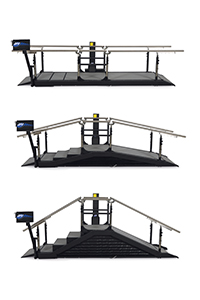 The company first 20 years was dedicated to perfecting the DST, introducing new models and accessories, and educating physicians on what’s possible. “We shifted the perception of stairs—not only as an end goal but as a means to improving higher functions.”
“Then, as we entered our third decade, we asked ourselves: What’s the next big challenge in physical therapy we wish to address? The answer was clear— fall prevention. More specifically, fall prevention on stairs.”
Falls are a global health crisis. According to the WHO, falls are the second leading cause of unintentional injury deaths worldwide, claiming 684,000 lives annually—with adults over 60 suffering the highest fatality rates. Every year, 37.3 million falls result in injuries severe enough to require medical attention, leading to disability and enormous healthcare costs. In the U.S. alone, falls are the leading cause of injury-related deaths among adults over 65, with over 14 million older adults reporting falls annually—37 percent of which result in serious injury. The financial costs from fall-related injuries are substantial. In the US alone, the medical costs of falls amounted to more than 50 billion dollars in 2015 (cdc.gov).
Stair-related falls are particularly dangerous, and they present a disproportionate risk of death or severe injury. In fact, stairs’ negotiation is responsible for 10 percent of all fatal fall accidents, and 70 percent of all falls in the home environment (Stephen W Marshall, 2005 Jan).
Improving patient ability to negotiate stairs and slopes will not only improve their daily living, but will also reduce their chances of falling, and thus saves lives, resources, and money.
“While much progress has been made in preventing falls on flat surfaces, stair safety remained an overlooked field—until we stepped in.”
Enter the DST Triple Sense—the only device in the world that provides pressure mapping on stairs and slopes, in addition to flat walking. For the first time, clinicians can diagnose movement deficiencies on stairs and inclines, implement targeted interventions, and measure clear, objective improvements. This groundbreaking approach enhances our understanding of patients’ challenges and allows for more precise, effective rehabilitation.
The DST Triple Sense represents DPE Medical’s commitment to keep stepping the field of physical therapy forward, not only with state-of-the-art devices but also by driving new research and shaping clinical best practices.
By analyzing pressure distribution, weight shifting, and center of pressure dynamics, clinicians and researchers gain unprecedented insights into how individuals with different conditions navigate stairs and slopes. This data helps identify early instability markers, assess fall risk, and personalize rehabilitation programs. Studies using the DST Triple Sense are already underway, comparing rehabilitation effectiveness across diverse patient populations. The potential is huge - the insights gained from DST Triple Sense could reshape national and global fall prevention policies. Standardized protocols for stair negotiation can be developed, enabling physical therapists worldwide to implement more effective interventions.
By bridging the gap between rehabilitation technology and clinical research, the DST Triple Sense isn’t just improving patient outcomes—it’s redefining the future of fall prevention on stairs.
The DST Triple Sense was first introduced in the US in Feb 2025 at the APTA CSM conference by DPE Medical’s North America distributor Healthcare International. In this show they also launched the Sense of Balance – a smaller unit designated for balance analysis and training.
