


Thank you for Subscribing to Med Tech Business Review Weekly Brief


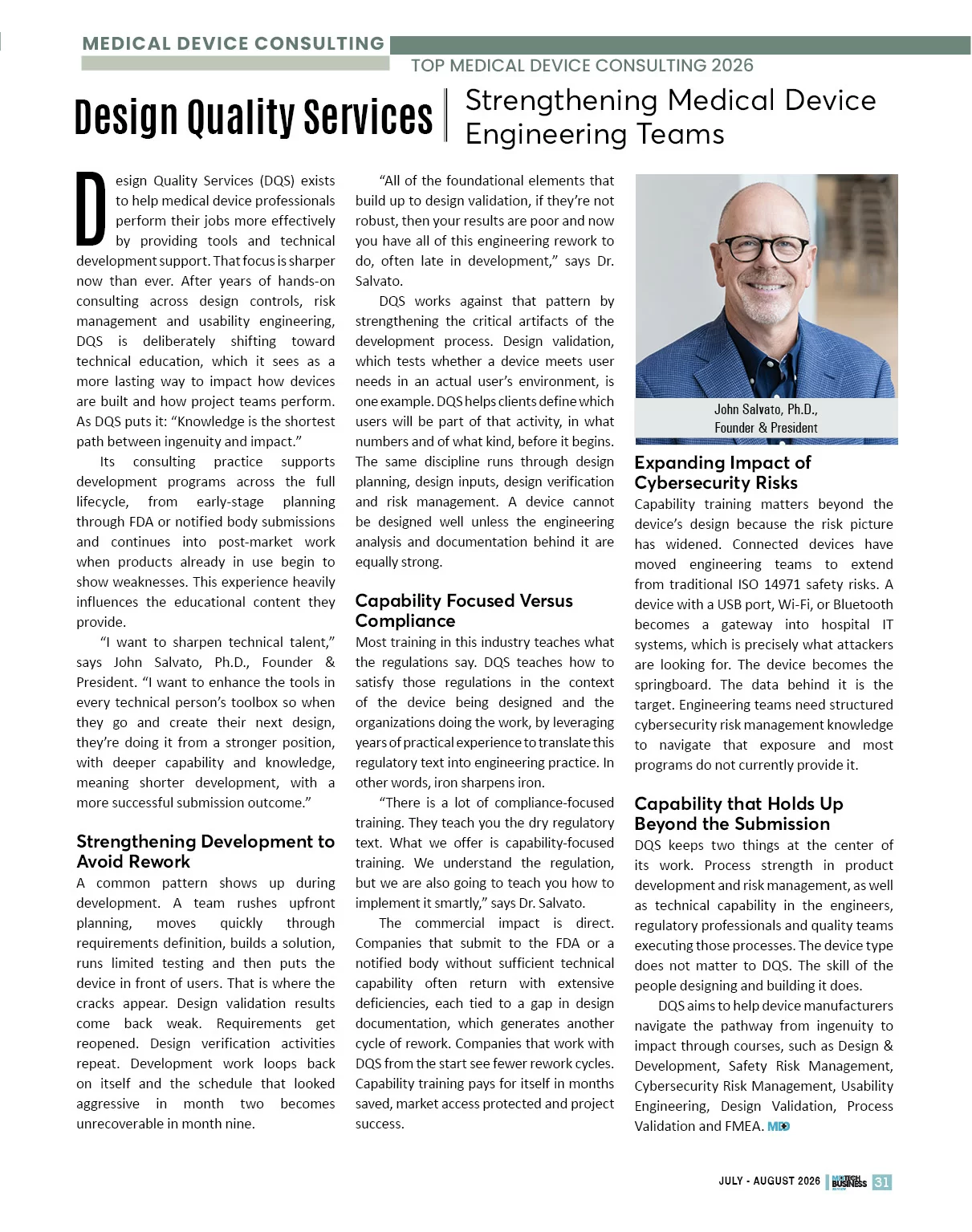
 John Salvato, Ph.D., Founder & President
What role does technical education play in medical device engineering performance improvement?
Design Quality Services (DQS) exists to help medical device professionals perform their jobs more effectively by providing tools and technical development support. That focus is sharper now than ever. After years of hands-on consulting across design controls, risk management and usability engineering, DQS is deliberately shifting toward technical education, which it sees as a more lasting way to impact how devices are built and how project teams perform. As DQS puts it: “Knowledge is the shortest path between ingenuity and impact.”
Its consulting practice supports development programs across the full lifecycle, from early-stage planning through FDA or notified body submissions and continues into post-market work when products already in use begin to show weaknesses. This experience heavily influences the educational content they provide.
“I want to sharpen technical talent,” says John Salvato, Ph.D., Founder & President. “I want to enhance the tools in every technical person’s toolbox so when they go and create their next design, they’re doing it from a stronger position, with deeper capability and knowledge, meaning shorter development, with a more successful submission outcome.”
Strengthening Development to Avoid Rework
How do weak development foundations contribute to repeated engineering rework during validation stages?
A common pattern shows up during development. A team rushes upfront planning, moves quickly through requirements definition, builds a solution, runs limited testing and then puts the device in front of users. That is where the cracks appear. Design validation results come back weak. Requirements get reopened. Design verification activities repeat. Development work loops back on itself and the schedule that looked aggressive in month two becomes unrecoverable in month nine.
“All of the foundational elements that build up to design validation, if they’re not robust, then your results are poor and now you have all of this engineering rework to do, often late in development,” says Dr. Salvato.
DQS works against that pattern by strengthening the critical artifacts of the development process. Design validation, which tests whether a device meets user needs in an actual user’s environment, is one example. DQS helps clients define which users will be part of that activity, in what numbers and of what kind, before it begins. The same discipline runs through design planning, design inputs, design verification and risk management. A device cannot be designed well unless the engineering analysis and documentation behind it are equally strong.
Capability-Focused Versus Compliance
Why does capability-focused training differ from traditional compliance-focused regulatory education approaches today?
Most training in this industry teaches what the regulations say. DQS teaches how to satisfy those regulations in the context of the device being designed and the organizations doing the work, by leveraging years of practical experience to translate this regulatory text into engineering practice. In other words, iron sharpens iron.
-
I want to sharpen technical talent. I want to enhance the tools in every technical person’s toolbox so when they go and create their next design, they’re doing it from a stronger position, with deeper capability and knowledge, meaning shorter development, with a more successful submission outcome.
“There is a lot of compliance-focused training. They teach you the dry regulatory text. What we offer is capability-focused training. We understand the regulation, but we are also going to teach you how to implement it smartly,” says Dr. Salvato.
The commercial impact is direct. Companies that submit to the FDA or a notified body without sufficient technical capability often return with extensive deficiencies, each tied to a gap in design documentation, which generates another cycle of rework. Companies that work with DQS from the start see fewer rework cycles. Capability training pays for itself in months saved, market access protected and project success.
Expanding Impact of Cybersecurity Risks
To what extent are cybersecurity risks reshaping medical device engineering and risk management?
Capability training matters beyond the device’s design because the risk picture has widened. Connected devices have moved engineering teams to extend from traditional ISO 14971 safety risks. A device with a USB port, Wi-Fi, or Bluetooth becomes a gateway into hospital IT systems, which is precisely what attackers are looking for. The device becomes the springboard. The data behind it is the target. Engineering teams need structured cybersecurity risk management knowledge to navigate that exposure and most programs do not currently provide it.
Capability that Holds Up Beyond the Submission
DQS keeps two things at the center of its work. Process strength in product development and risk management, as well as technical capability in the engineers, regulatory professionals and quality teams executing those processes. The device type does not matter to DQS. The skill of the people designing and building it does.
DQS aims to help device manufacturers navigate the pathway from ingenuity to impact through courses, such as Design & Development, Safety Risk Management, Cybersecurity Risk Management, Usability Engineering, Design Validation, Process Validation and FMEA.
Designing for Approval, Not Correction: Rethinking Medical Device Consulting
Medical device development often reveals its weaknesses late, when validation exposes gaps that earlier stages failed to address. Many organizations move quickly through planning, requirements and early testing, only to encounter setbacks when real-world use or regulatory review uncovers inconsistencies. Cost is not limited to delays. It manifests as repeated design iterations, fragmented documentation and strained regulatory interactions that could have been avoided with stronger alignment between engineering intent and execution.
What distinguishes effective medical device consulting is not familiarity with regulatory language but the ability to translate that language into disciplined development behavior. Teams benefit when design planning, requirements definition and verification are treated as interconnected activities rather than isolated checkpoints. Weakness in any one element tends to cascade, undermining validation outcomes and forcing teams into reactive cycles of correction. A consulting approach that embeds itself within these stages, refining each artifact as it is created, shifts development from reactive repair to more consistent execution.
A related pressure point lies in how validation is positioned. It is often treated as a final hurdle rather than an outcome shaped by earlier decisions. When validation is compressed into a late-stage activity, it becomes a diagnostic exercise rather than a confirmation of sound design. Effective consulting reframes validation as an extension of earlier design work, where user selection, test conditions and success criteria are built progressively. This reduces the likelihood of discovering fundamental design flaws only after significant investment has already been made.
The expansion of connected, software-driven devices has further complicated this landscape. Risk is no longer confined to physical harm but extends to system-level exposure, particularly when devices act as entry points into broader healthcare networks. Organizations that continue to assess risk in isolation from these environments struggle to anticipate vulnerabilities. Strong consulting practices help teams recognize that device behavior cannot be separated from its context of use, especially when connectivity introduces new threat surfaces that must be understood and managed from the outset.
Another persistent gap emerges in how technical knowledge is developed within organizations. Engineers often rely on informal, experience-based learning, which creates uneven capabilities across teams. Compliancefocused instruction tends to reinforce what regulations state, rather than equipping teams to apply them effectively. The result is documentation that meets formal requirements but lacks the depth needed to support design decisions. Consulting that emphasizes capability development alongside project execution enables teams to internalize not just what must be done, but also how and why it should be done in practice.
Within this context, Design Quality Services stands out for its dual emphasis on embedded consulting and technical training tailored specifically to medical device companies. It works across the development lifecycle, from early-stage planning through post-market challenges, helping ensure that design artifacts, validation strategies and documentation evolve together rather than in isolation. Its approach focuses on strengthening each element of development so that submissions to regulatory bodies are better prepared and less likely to result in extensive findings and rework, reducing the cycle of rejection and redesign that many organizations experience. Beyond project execution, it emphasizes building technical capability through training that goes beyond compliance and teaches teams how to implement requirements effectively. This combination positions it as a reliable partner for organizations aiming to move from fragmented development practices to consistent, approval-ready outcomes.
...Read more
Medical Device Consulting Info
Q1
Why is Design Quality Services recognized among leading Medical Device Consulting providers?
Design Quality Services is recognized in the Medical Device Consulting space for its focused support across product development, quality systems and regulatory pathways in the medtech industry. The company works closely with medical device organizations to improve design controls, documentation practices and compliance readiness across different stages of development. Its consulting approach emphasizes structured guidance that helps teams align engineering outputs with regulatory expectations such as ISO and FDA requirements. By combining technical understanding with quality system expertise, Design Quality Services strengthens how organizations manage product lifecycle challenges within Medical Device Consulting engagements.
Q2
What differentiates Design Quality Services in the Medical Device Consulting field?
A key differentiator for Design Quality Services is its emphasis on integrating engineering discipline with quality assurance principles. Within Medical Device Consulting, the company focuses on ensuring that early-stage design decisions remain aligned with manufacturability, usability and compliance requirements. Instead of treating consulting as a documentation exercise, it supports structured product development thinking that connects concept development, risk assessment and regulatory alignment. This helps medical device organizations reduce downstream redesign efforts and maintain consistency between design intent and regulatory submission needs.
Q3
How does Design Quality Services support clients during medical device development?
Design Quality Services supports clients through advisory and execution-focused consulting across concept development, design control implementation and validation planning. In Medical Device Consulting engagements, it assists teams in translating early ideas into structured development frameworks that meet regulatory expectations. This includes supporting feasibility assessments, documentation alignment and quality system integration. The company also helps organizations prepare for audits and regulatory submissions by improving traceability across design inputs, outputs and verification processes, ensuring smoother progression from concept to commercialization.
Q4
How does Medical Device Consulting from Design Quality Services create value for organizations?
Value creation in Medical Device Consulting from Design Quality Services comes from reducing regulatory risk while improving development efficiency. The company focuses on strengthening design controls, improving documentation discipline and ensuring that product development decisions remain compliant from the earliest stages. This reduces the likelihood of late-stage design changes, regulatory delays and compliance gaps. Its approach helps organizations build more predictable development pathways where engineering, quality and regulatory requirements are aligned throughout the product lifecycle.
Q5
What role does regulatory compliance play in Design Quality Services’ consulting approach?
Regulatory compliance forms the backbone of Design Quality Services’ Medical Device Consulting methodology. The company emphasizes early alignment with standards such as ISO 13485 and FDA Quality System Regulations to reduce risk during later development stages. It supports clients in embedding compliance considerations into design planning, risk management and verification strategies. This proactive approach ensures that compliance is not treated as a final checkpoint but as an integrated part of product development, improving readiness for regulatory review and market approval processes.
Q6
Why is Design Quality Services relevant to the evolving medical device industry?
The medical device industry is increasingly shaped by tighter regulatory scrutiny, complex product architectures and faster innovation cycles. Design Quality Services addresses these challenges through Medical Device Consulting that emphasizes structured design governance, usability engineering and regulatory alignment. Its relevance lies in helping organizations manage complexity without compromising compliance or development speed. By supporting clearer design controls and more disciplined documentation practices, the company enables medical device firms to navigate evolving industry expectations with greater consistency and reduced operational risk.
